The Academic Roadmap
A guide for students in academia, to help reel them back in for when they feel lost.
Sasha Bansal
5/19/20266 min read
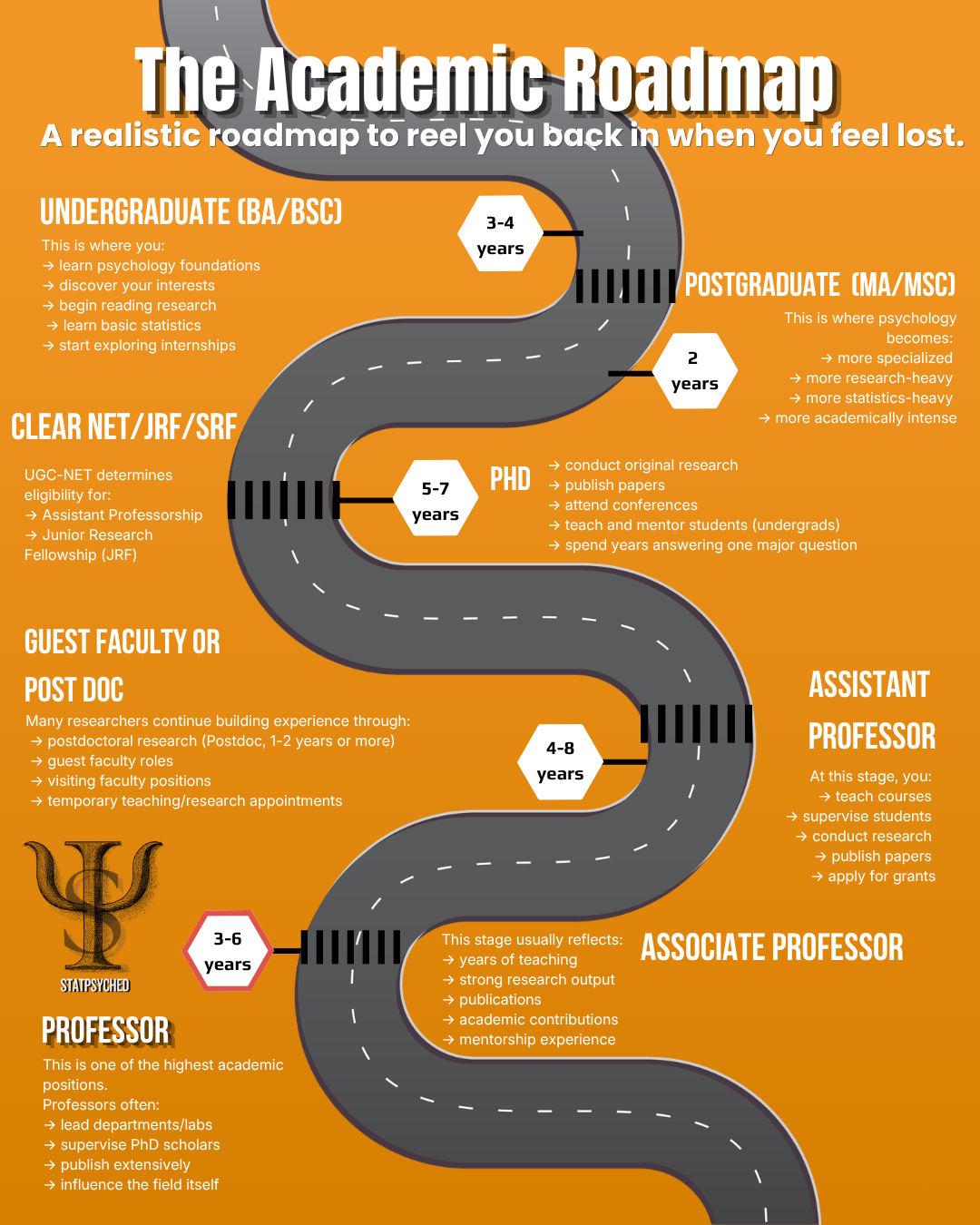
If you’re reading this, chances are you’re interested in psychology, research, academia, teaching, higher education, or maybe you’re just trying to figure out what your future in this field could look like.
One thing I realized very early on is that academia is incredibly gatekept. Students are mostly just expected to “figure things out” on their own without anyone properly explaining:
how the academic route actually works
what research looks like in real life
what different positions mean
how long everything takes
how people get opportunities
what skills actually matter
So I curated this blog to simplify things a little. This is not the only path in psychology. But if you’re interested in academia, research, teaching, or higher education, this roadmap will help you understand the system better. Let’s begin.
Academia, Ungatekept
- By Sasha
Stage 1: Undergraduate (BA/ BSc)
An undergrad is the foundational base stage and is of 3 to 4 years. This is where you learn the basic psychology theories, get an introduction to statistics and research methodology, understand the different branches of psychology and the basics of psychological testing.
What you SHOULD focus on during this stage:
Build strong conceptual understanding
Learn statistics early
Start reading research papers
Explore internships, not only clinical but also academic
Learn APA formatting
Learn how research actually works
Common Mistake: Thinking psychology is ONLY therapy.
Psychology is also:
research and academia
behavioral science
UX research
data analysis
psychometrics
neuroscience
organizational psychology and MUCH more
Most students wait too long before learning statistics and research skills properly. The earlier you become comfortable with them,
the easier psychology becomes later.
Stage 2: Postgraduate (MA/ MSc)
This is where psychology becomes more specialized and academically intense. Depending on your specialization, you may focus on any of the following: clinical psychology, counseling psychology, cognitive psychology, social psychology, developmental psychology, industrial psychology, research psychology etc. A master's is where you conduct research, write a research, learn advanced stats, present papers and attend conferences, use software like SPSS, R, or Jamovi, and begin networking academically.
Skills that matter here:
research and literature review writing
academic reading
statistics
presentation skills
critical thinking
Imposter syndrome becomes VERY common during postgrad.
Most students feel lost at some point.
That does not mean you are incapable.
Stage 3: UGC NET/JRF
The UGC-NET (University Grants Commission National Eligibility Test) is a single exam that has three qualifying cut offs. Depending on your score, it decides your eligibility for enrolling in a PhD program, applying for assistant professor positions, and eligibility to get JRF(Junior Research Fellowship).
The lowest cut off is for PhD only. In 2025, the cutoff for PhD only for the unreserved category stood at 182 marks (out of 300). Many universities have their own exam as an entrance test for a PhD. A candidate can either attempt the university's private exam, or submit their NET score to directly get an interview (Example, Ashoka University).
Qualifying the NET also makes one eligible for Assistant Professorship. This essentially means you meet the academic eligibility criteria required for teaching positions in universities and colleges. While a PhD has increasingly become important and often expected in academia today, NET still remains a significant academic milestone and is considered an important credential in higher education spaces. In 2025, the cutoff for AP in UGC-NET stood at 206 marks.
JRF, or Junior Research Fellowship, is generally considered the more competitive qualification because it comes with research funding support. Students who qualify for JRF usually receive a monthly stipend that financially supports their research journey, especially during their PhD. For many aspiring researchers, this becomes incredibly valuable because it allows them to focus more seriously on research work, publications, conferences, and academic training without immediately worrying about financial instability. In 2025, the cutoff for JRF was 234 marks.
Later during the research journey, many scholars may transition into SRF (Senior Research Fellowship), which usually happens during advanced stages of research progression and continued funded work (post year 2 or 3 of PhD). In simple terms, you can think of JRF and SRF as stages within funded academic research training.
Currently, JRF provides a monthly stipend of ₹37,000 INR and SRF provides ₹42,000 INR monthly, plus 10,000 INR housing allowance.
One important thing students often misunderstand is that NET/JRF is not just “another exam.” It is deeply tied to the structure of Indian academia itself. It can influence:
eligibility for faculty positions
access to funded research opportunities
competitiveness for PhD admissions
academic credibility within research spaces
long-term academic career progression
At the same time, it is also important to remember that not qualifying immediately does NOT mean someone is unintelligent or incapable of succeeding in academia. Many excellent researchers and academicians take multiple attempts, switch paths, pursue research through alternative routes, or build strong academic careers outside the conventional timeline. Academia is rarely linear, even though people often present it that way online.
One insider tip that students rarely hear enough is this: trying to blindly memorize everything usually backfires. The students who tend to perform better are often the ones who focus on understanding concepts deeply, practicing previous year papers consistently, and building long-term familiarity with the subject rather than cramming information at the last minute.
Stage 4: PhD (Doctor of Philosophy)
A PhD can range between 3 to 7 years. Contrary to the raging stereotype, it is NOT 'more studying'. A PhD trains you to become an independent researcher. You’ll usually:
conduct original research
publish papers
attend conferences
teach students (undergrads) as a graduate assistant
work in labs as a research assistant
write extensively
specialize deeply in one topic and complete your thesis
Your PhD topic becomes a huge part of your academic identity.
Choose something you genuinely care about.
Skills That Matter:
research methodology
statistics
academic writing
resilience
communication
critical thinking
literature review skills
A huge part of a PhD is learning how to tolerate uncertainty. Research rarely goes perfectly.
That’s normal.
Reality Check: Academia can look glamorous online.
In reality, PhDs often involve:
failed analyses
rejected papers
long hours
revisions
confusion
burnout
persistence
And everyone struggles more than they admit.
Stage 5: Guest Faculty/ Post Doc
A postdoc is essentially a paid research job and an advanced research position pursued after completing a PhD. This stage is heavily research-focused and helps scholars strengthen their academic profile, publish more papers, build collaborations, and specialize further in a particular area of interest. Many researchers also use this phase to gain international exposure, work in labs, and prepare for long-term faculty positions.
Many early-career academicians begin teaching through guest faculty or visiting faculty positions. These are often temporary or contract-based teaching roles in colleges and universities that help researchers gain classroom experience and enter academic spaces professionally. This stage often helps build:
teaching experience
university exposure
academic confidence
professional networking
Stage 6: Assistant Professor
An Assistant Professor position is often one of the first major long-term academic roles in a university setting. At this stage, academics are expected to balance both teaching and research simultaneously. Contrary to popular belief, the role is not only about teaching classes. Research output, publications, conference participation, mentoring students, and academic contributions all become extremely important parts of the job.
Assistant Professors often:
teach undergraduate/postgraduate courses
supervise student projects and dissertations
conduct and publish research
attend conferences
apply for grants and academic funding
contribute to departmental work
In India, starting salaries for Assistant Professors can vary significantly depending on institution type (govt. or pvt.), university reputation, location, research profile, and experience. Very roughly, salaries may range from ₹50,000/month to ₹1.5 lakh+/month
(and sometimes higher in certain institutions or international/private settings).
Many academicians spend around 8–12 years in this stage before progressing to Associate Professor, although this timeline varies heavily depending on publications, teaching experience, institutional requirements, grants, networking, and overall research contribution. Academic progression is rarely based on time alone.
A strong publication record and academic networking matter far more than most students initially realize. In academia, visibility, collaborations, mentorships, and consistent research output genuinely shape long-term opportunities.
Stage 7: Associate Professor
The role of an Associate Professor is usually reached after several years of experience as an Assistant Professor along with strong academic and research contributions. By this stage, academicians are often expected to have an established research profile, consistent publications, teaching experience, and active involvement within the academic community.
Associate Professors often:
teach advanced undergraduate/postgraduate courses
supervise dissertations and research scholars
lead research projects
publish research extensively
mentor junior faculty and students
contribute to curriculum and departmental development
This stage usually reflects years of:
research output
publications
conference participation
teaching experience
academic networking
institutional contribution
Very roughly, salaries may range from ₹1 lakh/month to ₹2 lakh+/month (and potentially higher in senior private or international institutions). This salary range is flexible and depends on a multitude of factors like location, institution type (govt or pvt), experience etc.
Progression to this stage is usually not based only on years of experience. Many universities evaluate faculty through systems like API/CAS scores, publication records, research impact, grants, and overall academic contribution. In many cases, academicians may spend several years building publications, supervising research, and strengthening their academic profile before promotion.
Stage 8: Professor
Professor is one of the highest academic positions within a university system and usually reflects years, and often decades, of contribution to research, teaching, mentorship, and academia as a whole. By this stage, academicians are often recognized not only for teaching, but for their influence within their field of specialization.
Professors often:
lead departments, labs, or research centers
supervise PhD scholars and research teams
publish extensively
guide major research projects and grants
mentor junior faculty and students
contribute to policy, curriculum, and institutional development
represent the university at conferences and academic forums
In India, salaries for Professors , salaries may start from several lakhs per month especially in senior leadership positions, reputed private universities, international academia, or consulting/research-intensive roles.
Reaching this stage usually requires years of:
research publications
teaching experience
API score
conference contributions
funded projects/grants
academic leadership
institutional and research impact
You are not “behind.”
Most students are trying to navigate systems they were never properly taught to understand. Take things one step at a time. Build skills gradually. Stay curious. Ask questions.
And remember that uncertainty is part of the process.
Welcome to StatPsyched, your trusted platform for psychology research & statistics learning.
Making statistics & research methodology accessible for students everywhere.
© 2025. All rights reserved.